
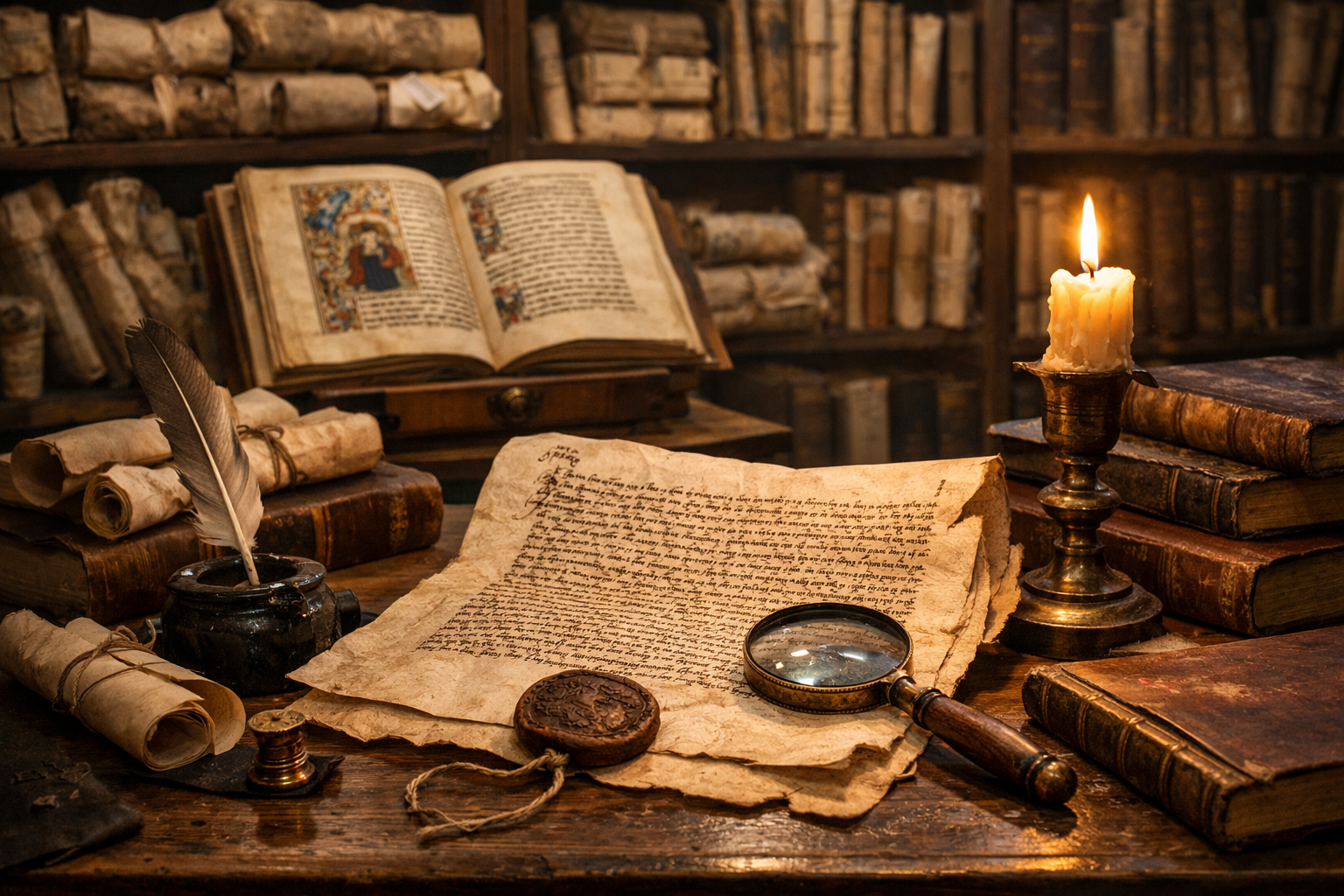
Why Archives Matter for Medieval History
Medieval Europe (roughly the 5th to the 15th century) left behind far more than castles and cathedrals. The era also produced an immense documentary footprint: legal instruments, financial accounts, monastic books, and private correspondence. These materials—preserved in repositories ranging from cathedral treasuries to modern national archives—form the backbone of history & archives as a field. While archaeology reconstructs lived spaces, archives reveal institutions, disputes, economies, and the language of authority itself.
Studying medieval archives is not only about reading old texts. It is also about understanding why documents were created in the first place: to record rights to land, to enforce obligations, to memorialize donations, to keep track of income, and to defend status. The archive, in other words, was a tool of governance and memory—one that shaped medieval society and continues to shape the histories written about it.
What Counts as a Medieval Archive?
Modern readers often imagine archives as orderly rooms of labeled folders. Medieval repositories were more varied. Some were literal chests in sacristies; others were cupboards attached to city halls; still others were bundles of rolls stored in administrative offices. The common thread is that documents were preserved for reference, proof, and continuity.
Key medieval record types include:
- Charters: Written grants or confirmations, typically concerning land, privileges, or rights; authenticated by seals.
- Cartularies: Manuscript books compiling copies of important charters, often assembled by monasteries or bishops to consolidate claims.
- Manorial and estate records: Surveys, rentals, and labor obligations that illuminate rural life and seigneurial control.
- Town and guild registers: Ordinances, membership lists, and commercial regulations reflecting urban growth and craft organization.
- Royal and papal records: Chancery outputs, letters, privileges, and fiscal accounts revealing state formation and church administration.
- Law court materials: Plea rolls, inquisitions, and notarial instruments capturing disputes and social relationships.
How Medieval Documents Were Made
Most medieval records were written on parchment (prepared animal skin) and, increasingly later, on paper. Ink recipes varied, and pens were often cut from quills. Documents were drafted by scribes trained in specific scripts—Caroline minuscule, Gothic bookhand, or local chancery styles—each with conventions that help specialists date and locate a text.
Authenticity relied heavily on material features. Seals—wax impressions made using engraved matrices—served as signatures for rulers, bishops, and institutions. Witness lists, distinctive formulae, and layout conventions also functioned as validation. This means the physical document is not merely a container for words; it is itself evidence, with clues embedded in handwriting, parchment quality, seal attachment, and even folding patterns.
The Social Life of Recordkeeping
Archives were produced by people with interests. A monastery might preserve donations to defend its estate against rivals. A king’s chancery recorded grants to reward loyalty and stabilize governance. Town councils documented bylaws to regulate markets and settle conflicts. The selective nature of preservation—what was copied into cartularies, what was kept, what was discarded—creates a medieval “paper economy” where power and paperwork reinforce one another.
Where Medieval Archives Lived
Before centralized state repositories became common, documents often remained close to the institutions that generated them. Over time, wars, reform movements, and political consolidation moved records into larger collections, sometimes saving them, sometimes scattering them.
- Monastic and cathedral archives: Among the richest sources, often preserving charters, cartularies, necrologies, and liturgical books.
- Royal administrations: Chancery, exchequer, and council records—indispensable for political history and taxation.
- Urban archives: Council minutes, property registers, and guild records that reveal commercial and social networks.
- Notarial archives: Especially prominent in Mediterranean regions, where notaries created standardized contracts and copies.
The fate of these archives was tied to historical upheaval. Dissolutions of monasteries, the Reformation, revolutions, and modern wars all reshaped collections—sometimes concentrating records in state archives, sometimes destroying them, sometimes pushing them into private hands.
Reading the Middle Ages Through Archives
Medieval archives support big historical questions: How did states form? How did economies recover after plague? How did law operate in practice? Yet archives also excel at microhistory: reconstructing a village boundary dispute, tracking a merchant’s investments, or following a family’s strategies for inheritance.
They also correct stereotypes. The Middle Ages were not uniformly “illiterate” or administratively chaotic. In many regions, recordkeeping was intensive, and documentary culture expanded alongside commerce and institutional complexity. That said, survival is uneven: urban centers often leave thick archival trails, while marginalized groups may appear only indirectly—through court proceedings, tax lists, or hostile descriptions.
Common Challenges: Gaps, Bias, and Interpretation
Archives are not neutral. They privilege those with access to institutions that produce records. They also contain silences created by loss, selective preservation, and deliberate omission. Historians therefore combine archival reading with methodological caution:
- Provenance: Understanding how and why a record entered a collection.
- Paleography: Deciphering historical handwriting and abbreviations.
- Diplomatics: Analyzing document forms to assess authenticity and function.
- Contextual comparison: Cross-checking with archaeology, narrative sources, and material culture.
Forged Documents and the Politics of “Proof”
Medieval archives include forgeries—some crude, some sophisticated. Institutions sometimes fabricated or “improved” charters to protect claims in a world where written proof increasingly mattered. A forged charter can still be historically valuable: it reveals what an institution wanted to be true, what rights it considered essential, and what legal language carried authority at the time the forgery was produced.
Modern scholarship evaluates such records through handwriting analysis, formulaic comparison, seal study, and contextual plausibility. The goal is not simply to label a document true or false, but to understand its role in medieval legal and political culture.
From Parchment to Pixels: The Modern Archive
Today, medieval archives are increasingly accessible through digitization projects, online catalogs, and high-resolution imaging. Digital access reduces travel barriers and allows tools such as text search, multispectral analysis (to recover faded ink), and data-driven prosopography (mapping people and relationships across documents). Yet digitization is not a complete substitute for physical study: texture, seal attachment, and marginal features can be crucial, and not everything is photographed or described equally well.
Conservation and ethical stewardship also matter. Archivists balance access with preservation, manage climate-controlled storage, and document restoration interventions. In an era of rapid technological change, long-term digital preservation—file formats, metadata standards, and redundancy—has become a central part of keeping medieval history usable for future researchers.
Conclusion: Archives as the Medieval World’s Memory
Medieval history is often described as distant, but archives make it concrete. They preserve not only grand political acts, but also the routines of rent collection, the language of petitions, and the practical compromises of daily governance. By learning how records were created, authenticated, stored, and sometimes manipulated, we gain a sharper understanding of the medieval past—and of the enduring relationship between documentation and power. In the end, the archive is not just where medieval history is kept; it is one of the ways the Middle Ages were lived.